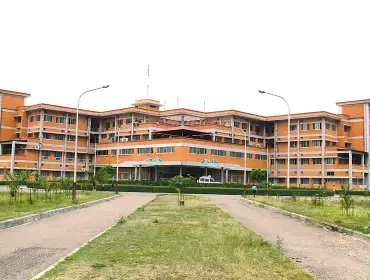
Discover why Nepalgunj Medical College is a top choice for aspiring medical students. Learn about its programs, campus facilities, and the opportunities it offers to shape a successful medical career.
The following are the methods for admission to Nepalgunj Medical College.
Complete your enrollment once you arrive and begin your education.
To secure MBBS admission in Nepalgunj Medical College, students must submit the following documents during the application and enrollment process:
Discover why Nepalgunj Medical College is a top choice for aspiring medical students. Learn about its programs, campus facilities, and the opportunities it offers to shape a successful medical career.
Nepalgunj Medical College (NGMC) is an institution having affiliations and recognitions that makes it trustworthy for furthering medical education. It is affiliated with Kathmandu University, which is one of the top rated universities in Nepal. The MBBS programs offered in Nepalgunj Medical College are recognized by the National Medical Commission (NMC) of India, thus enabling Indian graduates to sit for the FMGE/NEXT exam and practice medicine in India.
Moreover, NGMC is enumerated in the World Directory of Medical Schools (WDOMS) and recognized by the WHO. This enables graduates to pursue medical fields and obtain licenses in USA, UK, Australia and Canada. Also, the college is recognized by the NMC of Nepal, the Ministry of Education and the Ministry of Health of Nepal, thus fulfilling regulations on education and healthcare in Nepal.
Through these recognized accreditations, NGMC students are guaranteed global recognition and a curriculum aligned with global benchmarks. NGMC welcomes not only Indian students preparing for NEXT but also other MBBS students planning for USMLE or PLAB, offering them a sound academic foundation through its affiliations.
In accordance with Kathmandu University, the MBBS program in Nepalgunj Medical College is structured to be completed in 5.5 years. It is organized into two segments: 4.5 years of schooling and a 1-year mandatory internship. During the academic phase, students are trained in the fundamentals of medicine, pre-clinical and para-clinical subjects, as well as clinical rotations in multiple departments. The students are trained through lectures, laboratory classes, seminars, group work, and clinical apprenticeship in the hospital of the college which is well equipped.
In the final year, students undertake a rotating clinical internship, gaining supervised practical experience in diverse fields like medicine, surgery, pediatrics, and gynecology. This system equips students with strong theoretical and practical skills, enabling them to join the workforce as competent medical graduates immediately after graduation.
| Ranking Type | Rank/Position |
| National (Nepal) Rank | 20 |
| National (Nepal) Rank (Alternate) | 21 (Medical & Health Sciences) |
| World University Rank | 19,391 |
| World University Rank (Alternate) | 18,937 |
| Asia Rank (Medical & Health Sciences) | Not specified |
| Nepal Rank (Natural Sciences) | 19 (of 27) |
| Nepal Rank (Others) | 46 (of 50) |
| Among Top Private Medical Colleges in Nepal | Top 10 |
| Year / Semester | Subjects / Systems Covered |
| 1st Year | Semester I Basic Concepts, Autonomic Nervous System, Genetics, Immune System, Musculo Skeletal System, Integumentary System, Community Medicine, Introduction to Clinical Medicine (ICM) |
| Semester II Hematopoietic System, Respiratory System, Cardiovascular System, Community Medicine | |
| 2nd Year | Semester III Gastrointestinal System, Hepatobiliary System, Renal Electrolyte System, Metabolism & Endocrine System, Community Medicine, ICM |
| Semester IV Reproductive System, Growth and Development, Central Nervous System, Special Senses, Community Medicine, ICM | |
| 3rd Year | Semester V Medicine & Allied, Surgery & Allied, Obstetrics & Gynecology (Obs/Gyne), Pediatrics, Community Medicine |
| Semester VI Medicine & Allied, Surgery & Allied, Obs/Gyne, Pediatrics, Community Medicine | |
| 4th Year | Semester VII Medicine & Allied, Surgery & Allied, Obs/Gyne, Pediatrics, Community Medicine, Forensic Medicine, Otorhinolaryngology, Ophthalmology |
| Semester VIII Clinical Postings, Electives, Revision, Community Medicine | |
| 5th Year | Semester IX Clinical Postings, Electives, Preparation for Internship, Community Medicine |
| Internship 1 Year Rotating Internship in all Major Departments |
Nepalgunj Medical College ensures that all its MBBS students have a hostels which is safe, comfort and well organized. The hostels are separated for girls and boys, and includes essential furnishings like rooms, internet, and 24/7 water and electricity. In addition, the hostels are located near or on campus.
Typically two or three students share a room that has clean bathrooms, beds, wardrobes, and study desks. The college's mess serves indian meals and other nutritious and hygienic food, which is popular among the Indian students. The college also has recreational areas, reading rooms, and sports facilities, to promote good overall health.
Students living in the Nepalgunj Medical College as a medical student experience a safe and very disciplined environment, which is positive for personal development and academics. The culture is also very friendly.
Living costs for MBBS students at Nepalgunj Medical College are inexpensive, particularly for Indian and South Asian attendees. Generally, for INR 10,000 to 15,000 (approximately NPR 16,000 to 24,000), which includes hostel rent, food, transportation, internet, and books, students have several personal expenses. Students avoid substantial travel and food expenses because the college offers in-campus hostel and mess facilities. There are also benefits for Indian students from currency exchange. Overall, Nepalgunj is affordable, which enhances its appeal for those wishing to pursue an economical MBBS in Nepal.
Graduating MBBS from, Nepalgunj Medical College provides numerous career opportunities in Nepal and abroad. With the college's recognition from NMC, WHO, and WDOMS, students are eligible to take FMGE/NEXT, USMLE, PLAB, or AMC for practicing and further studies in their respective countries.
There is a trend among Indian students of returning to India to take the FMGE/NEXT to begin practicing or pursuing Masters-level programs. Many graduates choose to remain in Nepal for an internship or residency, and other graduates pursue their medical career in countries that accept degrees from recognized Nepalese institutions.
There are also non-clinical career pathways that include medical research, public health, hospital administration, clinical data analysis, and medical education. In addition, the rigorous academic training and clinical exposure at Nepalgunj Medical College make graduates attractive candidates for PG entrance exams in other countries.
Overall, the prospects are numerous and provide the opportunity to specialize professionally in clinical and non-clinical areas on a national and global scale.
After completing MBBS from Nepalgunj Medical College, students have various pathways to pursue a medical career in Nepal. Graduates can seek employment as general practitioners and apply for a medical license with the Nepal Medical Council (NMC), practicing in hospitals, clinics, or rural healthcare centers. There is an increasing quality and quantity of healthcare infrastructure in the country; therefore, both private and public sectors have an increasing need for qualified physicians.
Interest in further professional development allows pursuing postgraduate medical degrees (MD/MS) in Nepal via entrance tests organized by Kathmandu University or its other affiliated colleges. The PG programs offered in Nepal are recognized and are reputed to provide adequate clinical training in comparison to many other countries.
Additionally, students from nearby countries like India often complete an internship in Nepal and then go back home to take the NEXT or FMGE exams. The friendly academic climate alongside the instruction in English and organized clinical training makes it easier to prepare for advanced medical specialization in other countries.
To conclude, it can be said that Nepal provides numerous employment and education opportunities for the graduates willing to build their medical career prospects in the country first, or use it as a stepping stone for practicing medicine globally.
After completing MBBS in Nepalgunj Medical College, Indian and international students have various options to return and pursue a career in their home country.
Get expert guidance for your admission. Fill the form to connect with our specialists.